The Hidden Record
The Solar Ranch Case
In the summer of 1969, a raid on a remote desert compound near Vidal brought a little-known occult order — the Solar Lodge — into public view through the case that became known as the "Boy in the Box." What followed was an eighteen-month federal manhunt, a series of child-abuse convictions, the group's own defense newspaper, and a federal libel decision that entered much of the record into the courts.
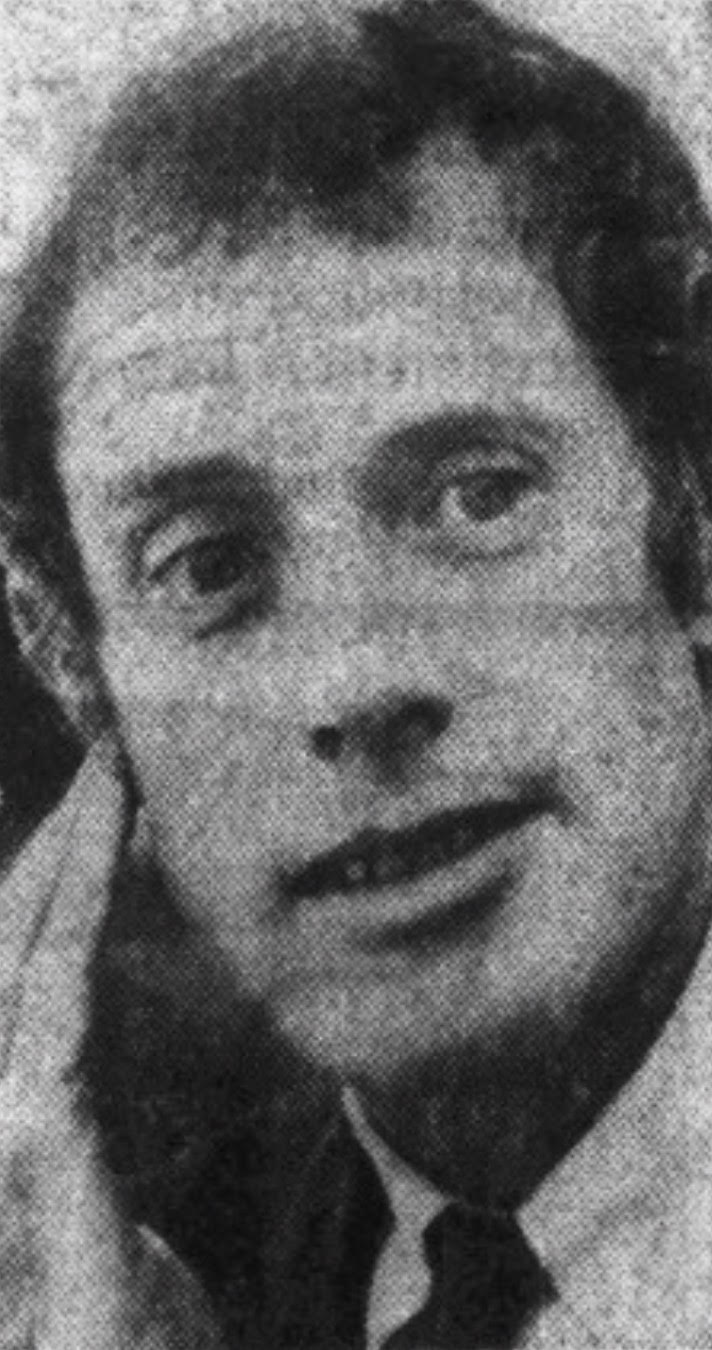
The desert has always drawn those who wish to be left alone, and in the late 1960s it drew a group that called itself the Solar Lodge. It had taken shape in Los Angeles in the mid-1960s around the writings of the English occultist Aleister Crowley, and it borrowed the name of the Ordo Templi Orientis, or O.T.O. — Crowley's magical order — though it operated apart from, and unrecognized by, the older lineage that bore that name. Its guiding figure was Georgina "Jean" Brayton, and among the group's properties was an isolated compound in the desert near Vidal, along Highway 95 north of Blythe, that its members called the Solar Ranch.
By the accounts of former members, the lodge was formally established in 1965, an outgrowth of an older, dissolved O.T.O. body whose surviving papers had passed to Jean Brayton. She and her husband, Richard "Dick" Brayton — a high-school civics teacher who by most accounts had little personal interest in the occult — ran a cluster of rooming houses near the University of Southern California, renting to students, some of whom joined the lodge. The group kept "Eye of Horus" bookstores in Los Angeles and later in Blythe, and, gripped by an apocalyptic conviction that the social order was about to collapse, its members began hauling disassembled Quonset huts into the desert near Vidal to raise a temple they called the Ark.
For most of its existence the group drew little notice. That changed abruptly in the summer of 1969, when what happened at the Solar Ranch became a national sensation under a grim and unforgettable name: the Boy in the Box.
The boy in the box
On June 10, 1969, a young boy at the ranch — six-year-old Anthony Saul Gibbons, the son of members — set a fire that spread quickly and, by the group's own later account, destroyed a building and a stack of Crowley's papers held on the premises. As punishment, the child was confined in a small wooden packing crate out in the open desert, his legs chained, and kept there through weeks of punishing summer heat, let out, he later testified, only to do his "chores."
On July 26, 1969, acting on reports reaching them, Riverside County deputies raided the Solar Ranch and freed the boy. Wire-service accounts that carried the story across the country described how the alarm had been raised when two men who came to the ranch to buy horses looked inside a nailed-shut packing crate and found the child; eight adults present were arrested that day. On August 13 a county grand jury returned a true bill charging nineteen members of the O.T.O. under California's child-abuse statute. The discovery of a child imprisoned that way in the Mojave shocked a public already braced for terrible news that summer — and it embedded the case in a darker national moment, for only weeks later the Manson Family murders in Los Angeles would seize the country's attention.
At the trial that fall, Anthony testified from a pillow set on the witness stand so that he could be seen above the rail. Barely audible, he told the court he had been burned with matches and shut in the sweltering crate for what the prosecution put at fifty-six days. His testimony helped convict seven of the defendants, including his mother, Beverly.
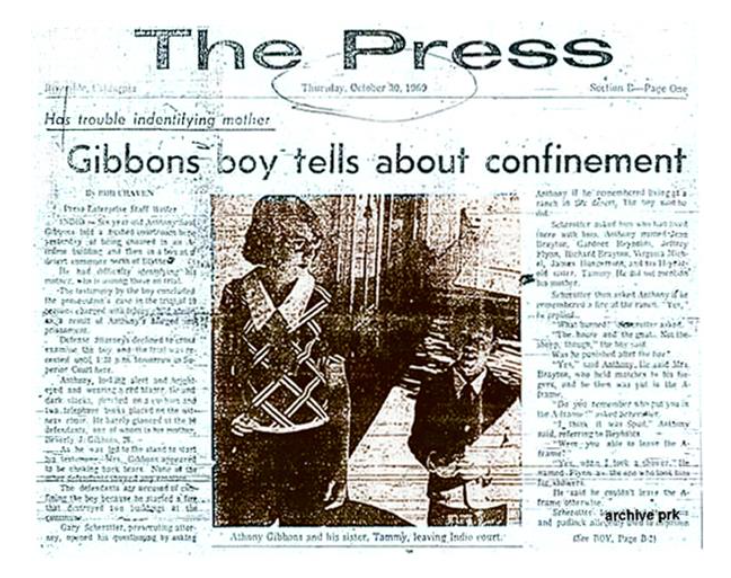
The raid and the image of a child kept chained in a box beneath the desert sun turned a little-known occult order into a subject of national headlines — and, eventually, of a federal courtroom.
The eighteen-month manhunt
Many of those charged never appeared for the raid. When investigators went looking, the Braytons and several others had vanished, and on August 15, 1969, the FBI opened a federal case for Unlawful Flight to Avoid Prosecution. Its files name the fugitives one by one — Georgina and Richard Brayton, the bookstore manager Robert Duerrstein, the dentist Edson Dunlap, and the boy's father, James Herbert Gibbons, a former Los Angeles County probation officer — and describe a group that had scattered across the Southwest, passing letters through an improvised chain of intermediaries to stay ahead of the warrants.
The manhunt ended in a pair of made-for-television moments. In August 1971, James Gibbons surrendered to sheriff's deputies in Palm Springs in a prearranged handover staged during a KPLM-TV interview — a scoop that later won the station's reporter, Vance Weber, a Golden Mike award. Weeks later the Braytons themselves were taken into custody by FBI agents and arraigned in Indio, ending nearly two years as fugitives.
The reckoning in court
The criminal case had already produced convictions — four defendants on felony child-abuse counts, including the boy's mother, and three on misdemeanors — and now it turned to those who had fled. In December 1971, James Gibbons and Jean Brayton each entered pleas of no contest under negotiated arrangements: three years' probation and a $500 fine, with no time in custody, subject to the sentencing judge's review. Charges against Richard Brayton were dropped for insufficient evidence.
Velle and the Midnight Press
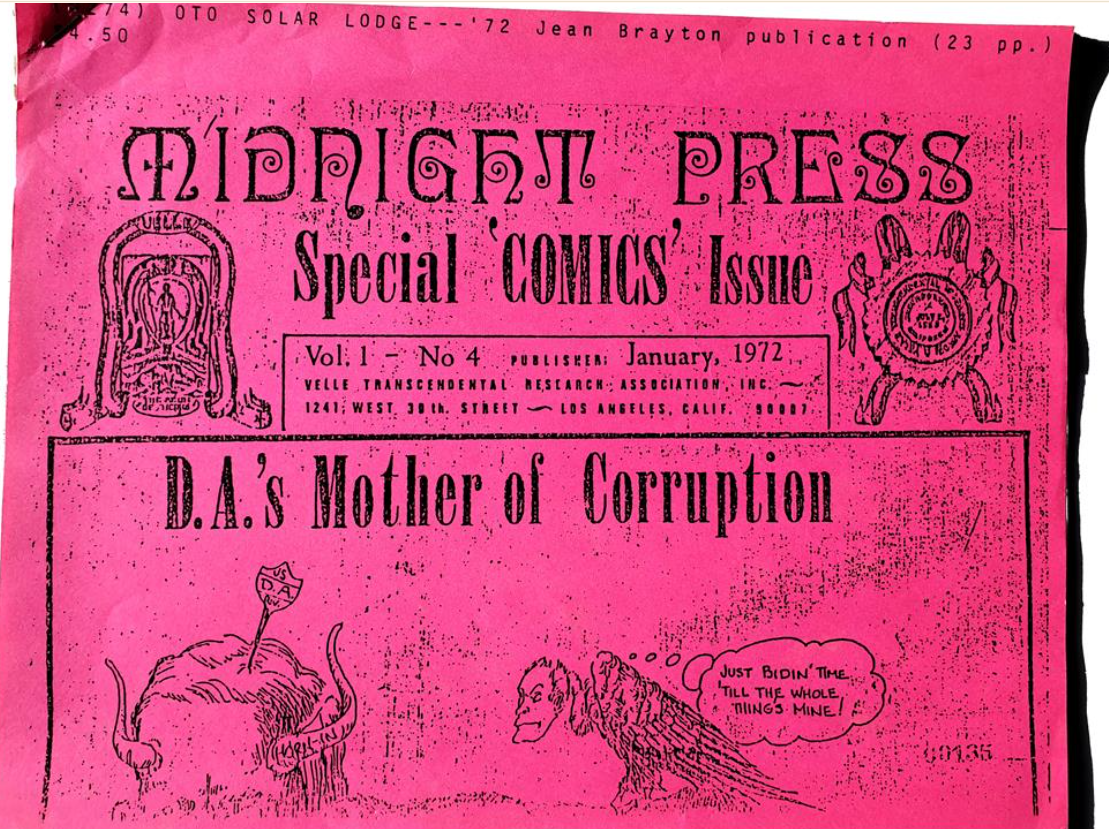
By the time of the pleas the group had reorganized under a new, secular-sounding name — the Velle Transcendental Research Association, Inc. — and its members now called themselves "Velleans." From an address on West 30th Street in Los Angeles they published a defiant homemade newspaper, the Midnight Press, that recast the entire affair as religious persecution. In its pages the Boy in the Box case was a frame-up, the Riverside courts a "railroad," and the prosecutors a corrupt clique.
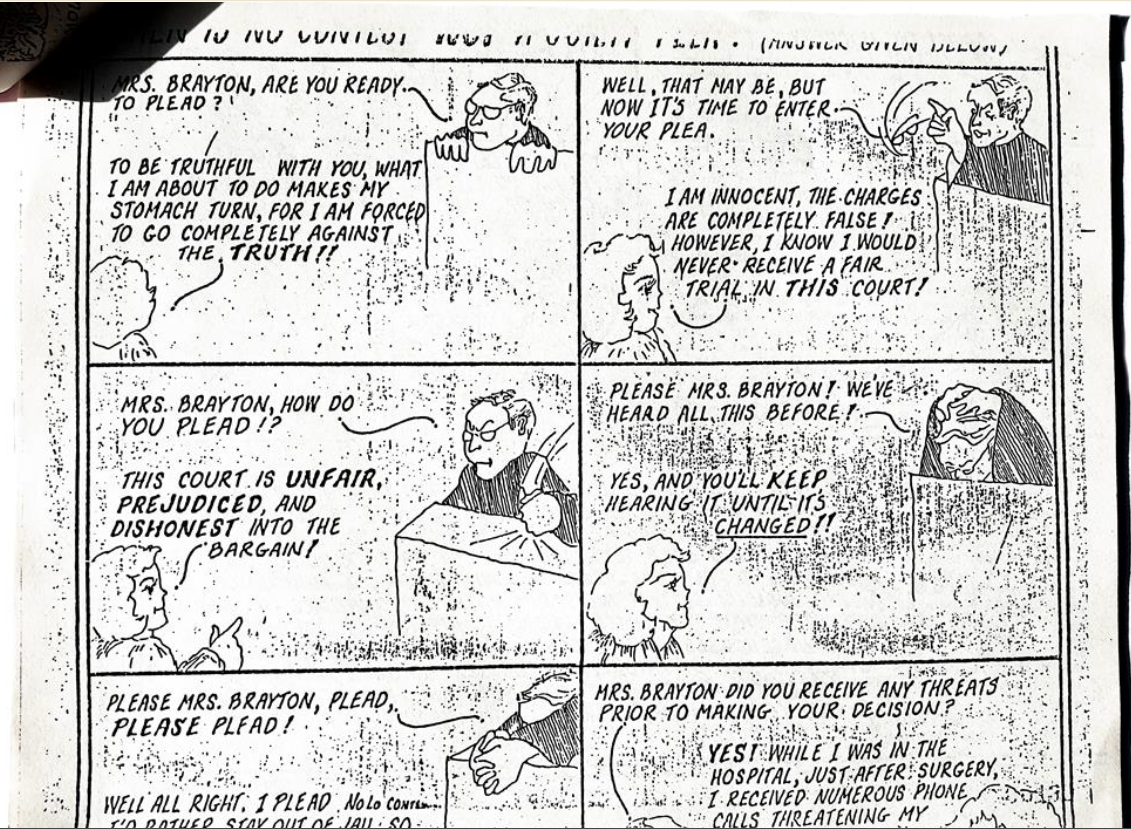
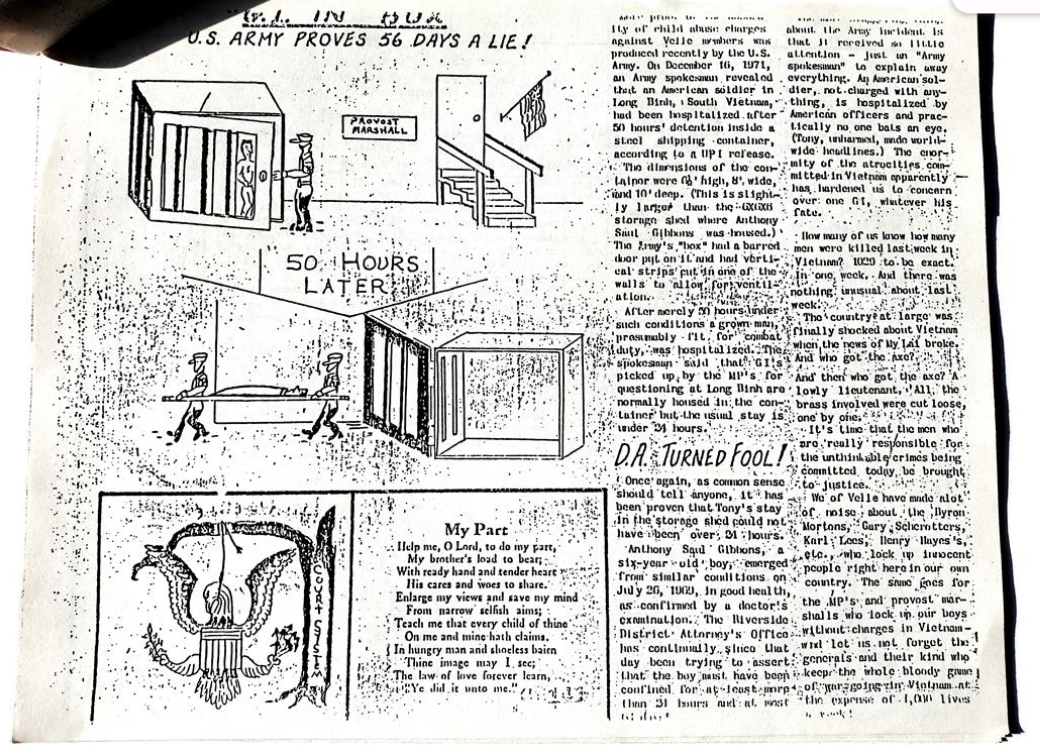
Much of the paper was given over to crude but pointed cartoons. One recurring strip mocked the district attorney's office; another, headlined "U.S. Army Proves 56 Days a Lie," seized on an unrelated Army confinement case to argue that the central charge against the group — fifty-six days in the box — could not be true, insisting instead that the boy had emerged "in good health as confirmed by a doctor's examination."
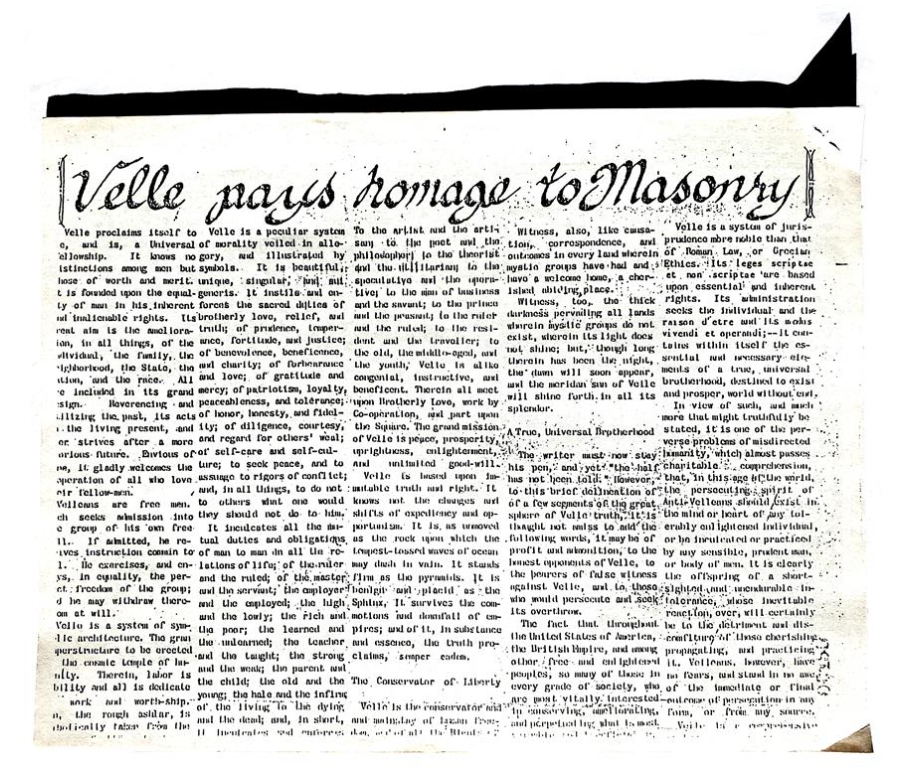
The Velleans also worked hard to dress the group in respectability. A long front-page essay, "Velle Pays Homage to Masonry," presented the organization as a "true, universal brotherhood" in the lineage of Freemasonry — a jurisprudence "nobler than that of Roman Law" — and described ritual invocations of the Egyptian god Tahuti. It was a striking distance from the packing crate in the desert.
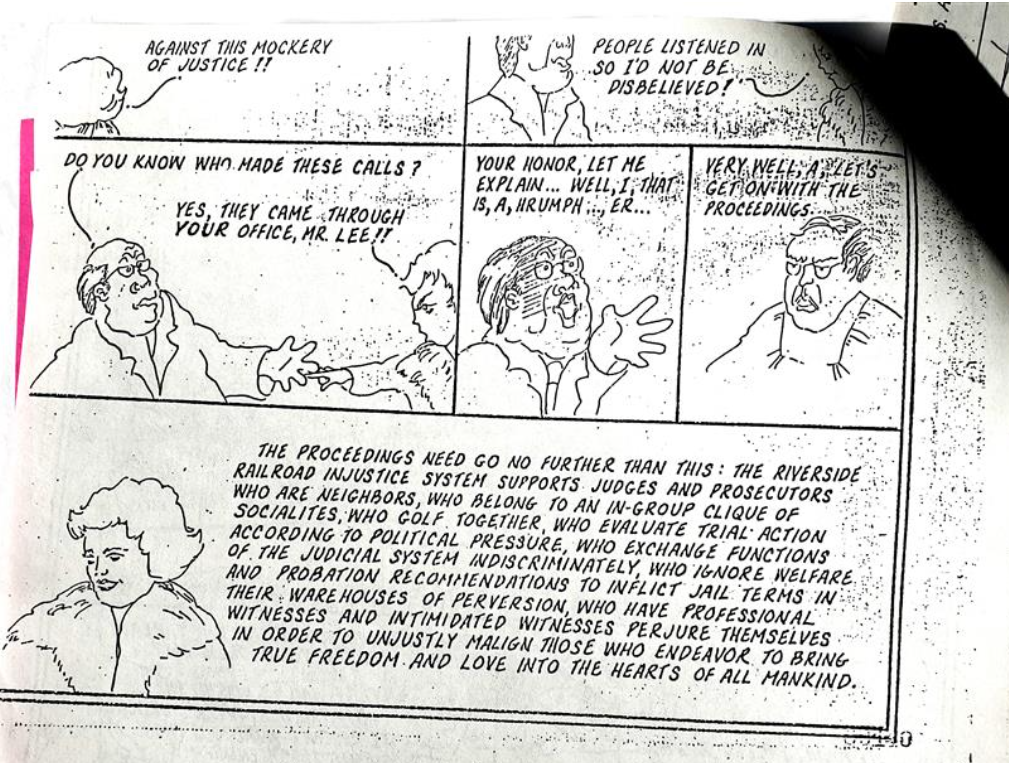
The paper reserved its sharpest attacks for the men who prosecuted the case. In one strip the group accused a court officer of orchestrating threatening telephone calls; in another, a full panel laid out the group's whole theory of a "Riverside Railroad Injustice System" of golfing judges and prosecutors who "perjure themselves in order to unjustly malign those who endeavor to bring true freedom and love into the hearts of all mankind."
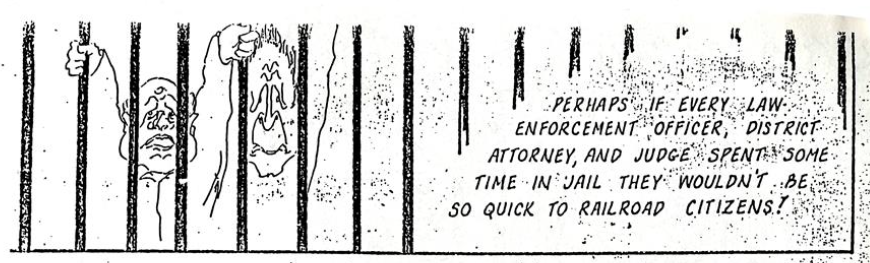
The Midnight Press printed appreciative letters from sympathizers and closed one issue with a cartoon that summed up its grievance: a face pressed between jail bars, and the wish that "if every law enforcement officer, district attorney, and judge spent some time in jail they wouldn't be so quick to railroad citizens."
A letter to the "Caliph"
Behind the bravado, the group was also maneuvering. On May 1, 1971 — while the Braytons were still, in effect, on the run — Dick Brayton wrote to Grady Louis McMurtry, a Crowley associate then working to rebuild the O.T.O. in America under the title "Caliph." Writing on Velle's behalf, Brayton acknowledged McMurtry's leadership and proposed a union of the two factions, arguing that only the "Pasadena scandal" kept them apart and that a merger could double their followers. He even asked McMurtry's members to write to the deputy district attorney in protest of the prosecutions — a "Plea for Religious Toleration."
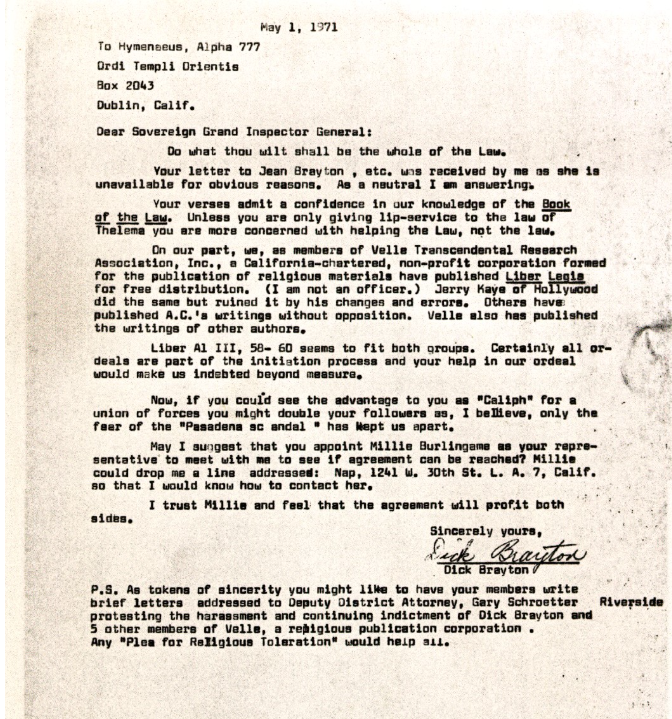
McMurtry rejected the overture, unwilling to tie his effort to a group mired in the Boy in the Box scandal. Historians of the O.T.O. have since argued that the affair, paradoxically, helped his cause: the notoriety of the Solar Lodge lent urgency and a certain legitimacy to McMurtry's rival organization, which in 1977 became the "Caliphate" O.T.O., the body that would dominate Thelemic circles in the decades that followed.
The Manson shadow
Because the case broke in the same summer and the same corner of Southern California as the Manson murders, the two stories were quickly braided together in the popular imagination. In his 1971 book The Family, the writer Ed Sanders devoted a chapter to the Solar Lodge, folding it into his sprawling account of the era's cultic underworld, and tabloids have linked Charles Manson to the group ever since. Careful researchers have found no substance to it: there is no verified evidence that Manson ever attended a Solar Lodge gathering, and the FBI's own files on the group do not mention him. The lodge did draw curious outsiders to its "profane parties" — among them Jerry Kay, an art director on the film Easy Rider, who took a probationer's oath and left with a copy of Crowley's Book of the Law — but that is a long way from the Manson legend.
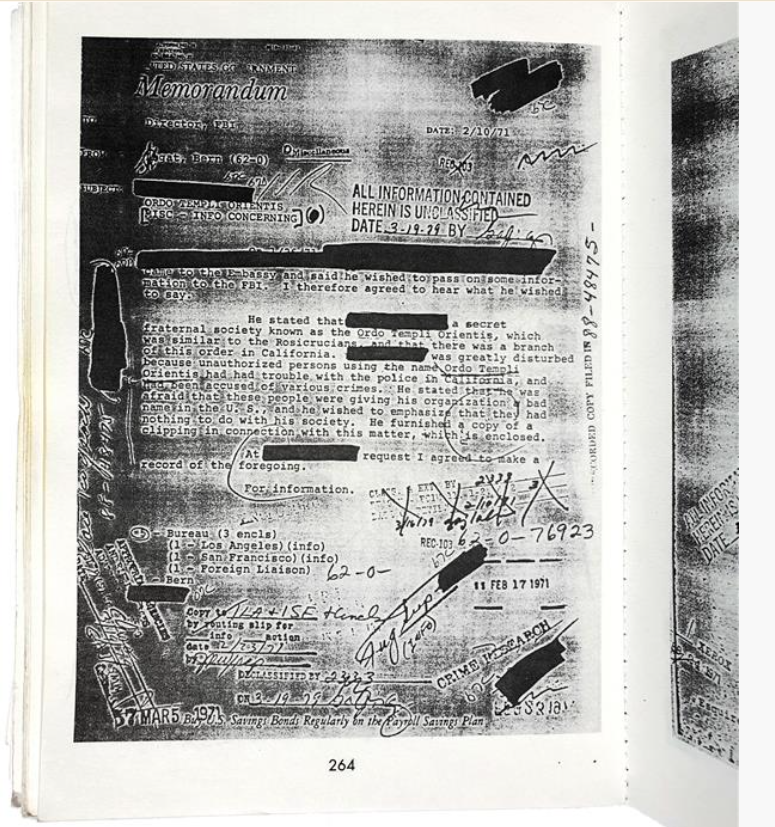
The notoriety even reached across the Atlantic. Alarmed by an October 1969 wire story about "chaining by cultists," the head of the Swiss O.T.O., Hermann Joseph Metzger, called at the American Embassy in Bern to tell the FBI that these people were giving his organization a bad name and that his society had nothing to do with them.
The federal record
The group did not go quietly into the archive. As the Velle Transcendental Research Association, it sued Ed Sanders and his publishers for libel over The Family. The resulting decision, Velle Transcendental Research Ass'n v. Sanders (1981), was handed down in federal court in the Central District of California, which found that through the notoriety of the Boy in the Box affair the organization had become a "public figure" — a ruling that placed a high bar on its libel claims and, in doing so, entered many of the case's underlying facts into the permanent legal record.

An insider's account
The documentary record — sheriff's reports, FBI files, court filings, and the group's own Midnight Press — can be set beside a later insider source. Writing under the magical name Frater Shiva, a former high-ranking member published a memoir, Inside the Solar Lodge: Behind the Veil, recounting his years in the order. Like any participant's recollection it is partisan and must be read with care, but it corroborates the essential dates and places and adds considerable detail about how the group understood itself.
By that account the lodge was organized as a strict initiatory hierarchy. To advance, a member was expected first to introduce two new members at his or her own grade; carried through an Outer Head and ten degrees, such a pyramid would have required 1,024 initiates. The order's constitution, the memoir notes, was to take force only when the membership reached "one thousand souls" — until then the Grand Master held final authority. In practice the Solar Lodge never approached those numbers: by 1969 it counted roughly forty-nine members and a handful of probationers, a structure solid only as high as the third degree, whose three lowest grades the group glossed, in its own symbolism, as Birth, Life, and Death.
The memoir also records the origins and geography of the desert properties. Solar Ranch, it explains, began simply as a place to rest and clean up after all-night ceremonies before it grew into the compound raided in 1969. Its ruined foundations, the account notes, lie in Riverside County about a mile west of the Colorado River and a mile east of Highway 95, just south of the San Bernardino County line — the open desert immediately around Vidal. The group is said to have kept other sites as well, among them a canyon it called the "Aries Vortex" in California's Red Rock country and a remote property across the border in Baja California.
One detail bears directly on Vidal. During the eighteen months the corporate officers spent in hiding — much of it in Prescott, Arizona — the memoir describes how contact was maintained with the members still holding the properties: telephone calls placed from public booths between the officers and the initiates "in Vidal, Blythe and Los Angeles," their contents disguised in Qabalistic cipher to defeat any eavesdropper.
The memoir also advances the group's long-standing claim that the most extreme details of the case originated with two members who, after the arrests, cooperated with prosecutors — figures the author calls Frater Ra and Frater Aero. In this telling the pair exaggerated the length and severity of the boy's confinement, and the author states that one of them later admitted inventing details to avoid prison. The claim cannot be independently verified, and it stands against the sworn testimony that produced the convictions; it is recorded here as the group's own account, consistent with the defense it had already published in the Midnight Press.
The members' later lives
Shiva's memoir closes with an "In Memoriam" that follows the members into later life, and it is a sombre catalogue. Several died young and in troubled circumstances: it records the death of a twenty-one-year-old initiate, Christopher Hartwell, and of two members, James Wellman and Julie Angelson, each at twenty-eight. Georgina "Jean" Brayton — Soror Capricornus, the group's Supreme Grand Master — is recorded as having died in July 1984, and the order's "Grand Architect" of Solar Ranch, an engineer and dental surgeon the memoir calls Frater Shem, in 1986. Offered as a memorial rather than a confession, the list is nonetheless a reminder of how many lives passed through this small desert order, and how heavy a toll the years exacted on them.
The desert's long memory
In time the Solar Lodge dispersed and the ranch near Vidal returned to silence. But the case left a lasting mark — a fixture of the true-crime and cultural histories of the late 1960s, and a reminder that the same isolation that drew prospectors, engineers, and soldiers to this desert could also shelter something far darker.
The Vidal Historical Society preserves this chapter not for its sensation but for its record: because the story is documented — in sheriff's files, in the FBI's files, in the courts, and even in the group's own defiant newspaper — and because an honest account of a place must include its hardest passages alongside its proud ones.
Sources & Further Reading
- "The Boy in the Box (Vidal, California)," Wikipedia.
- "Solar Lodge," Wikipedia — the group's founding, beliefs, and dissolution.
- Peter-R. Koenig, "Charles Manson and the Solar Lodge of the O.T.O." — a documentary reconstruction drawing on witness accounts, FBI files, and the group's own publications.
- Federal Bureau of Investigation, Los Angeles field-office file on the O.T.O. / Brayton fugitive case (UFAP — Child Abuse), 1969–1971, reproduced in Koenig's Materialien zum O.T.O.
- Midnight Press (Velle Transcendental Research Association), Vol. 1 Nos. 3–4, December 1971 – January 1972 — the group's own newspaper, including the "Special 'COMICS' Issue."
- Dick Brayton to Grady L. McMurtry, May 1, 1971 — the "union of forces" letter, reproduced in Koenig, above.
- Frater Shiva, Inside Solar Lodge — Outside the Law (Teitan Press, 2007) — a former member's account of the lodge's founding and desert "Ark."
- "Boy Tells of Chaining by Cultists," The Washington Post, October 30–31, 1969 (UPI) — Anthony Gibbons's courtroom testimony.
- Velle Transcendental Research Ass'n v. Sanders, 518 F. Supp. 512 (C.D. Cal. 1981).
- Ed Sanders, The Family (E. P. Dutton, 1971), ch. 9, "The Solar Lodge of the O.T.O."
- The Desert Sun, San Bernardino County Sun, and Oakland Tribune, 1971 — arrest, plea, and trial coverage via the California Digital Newspaper Collection.